Ihlara Valley Cappadocia: A Quiet Descent into Nature and Time
Discover Ihlara Valley in Cappadocia, where canyon walls, the Melendiz River and rock-cut churches create a quieter, deeper experience.
Ihlara Valley
When people think of Cappadocia, they usually picture pale stone, wind-carved shapes, and balloons floating in a bright sky. Ihlara Valley feels like a different sentence written on the back of that postcard. Less loud, less dramatic at first glance — but somehow more lasting. Because here, the main idea isn’t looking up. It’s going down.
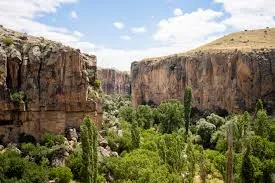
From the surface, the landscape can seem plain — a quiet plateau, open land, almost nothing begging for attention. And then the earth suddenly opens. You descend, and the world changes in a very physical way: steep canyon walls, shade, moisture, and the steady presence of water. The Melendiz River runs through the valley, and it doesn’t just decorate the view — it sets the pace. You walk to its rhythm. Sometimes it murmurs softly, sometimes it rushes, as if nudging you forward.
What makes Ihlara special isn’t only the greenery. In much of Cappadocia, nature feels sculptural — like a giant open-air gallery where the rocks are the main characters. In Ihlara, nature is more intimate. It holds you inside it. There’s a real sense of shelter: tree cover, birdsong, cool air that clings to the canyon. Even on a hot summer day, the moment you step down into the valley, the temperature shifts — and with it, your mind shifts too. Not in a mystical way, necessarily. More like your thoughts lose their sharp edges. You slow down because the place quietly insists on it.
And then there are the rock-cut churches and chapels, tucked into the valley walls as if they’re trying not to be noticed. History here isn’t behind glass; it sits right beside the path. Even if you’re not religious, these spaces have a way of stopping you for a moment. The frescoes — some vivid, some faded — carry a strange kind of honesty. The fading itself feels meaningful, like time didn’t fully erase the images, only softened them. Not completely forgotten, not fully remembered. Just… held.
Ihlara is also a lesson in contrasts. Above: dryness. Below: water. Above: wide openness. Below: a narrow corridor that feels alive. Above: wind and exposure. Below: shade and the softer sound of leaves. Seeing those opposites coexist makes you realize Cappadocia isn’t one single mood. Sometimes a landscape becomes more powerful when it shows you its own contradiction.
The walk through the valley isn’t just a checklist route. Yes, there are uneven stones, mild climbs, steps, the usual physical side of hiking. But the real shift happens when you stop trying to “capture” it and start letting it affect you. After a while, you take fewer photos — not because it’s less beautiful, but because beauty is no longer the main point. The coolness, the water, the echo of canyon walls — they create a state of mind more than a single image.
If there’s one clear feeling to take from Ihlara, it might be this: it’s Cappadocia speaking in a quieter voice. It doesn’t perform. It doesn’t shout. But once you’re inside, it makes your own inner noise easier to hear — and that, honestly, is why people end up remembering it.